
Cowichan Valley
Moss Off the Surfaces People Walk On
A green walkway is a slip hazard long before it looks bad, and wet winter mornings here are when people find that out.
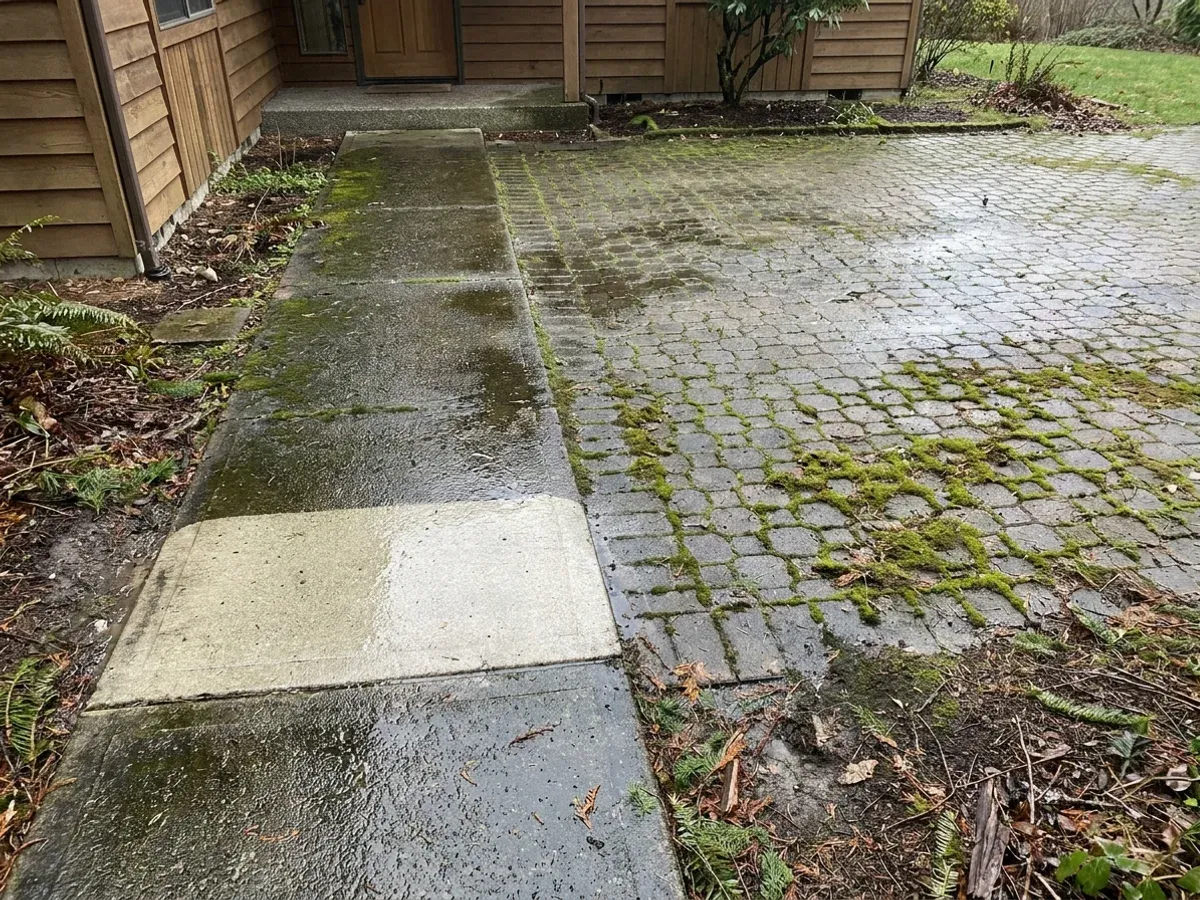
- Slip risk removed from steps, walkways and sloped driveways
- Pressure matched to concrete, pavers or exposed aggregate
- Jointing sand protected and replenished on paver surfaces
- Shade and drainage causes pointed out, not just the growth
- Runoff kept off beds, lawns and roadside ditches
- Licensed and insured, and local to the Cowichan Valley
Every other moss job on this site is about protecting a building. This one is about protecting the people using it.
A concrete walkway with a film of moss and algae on it becomes genuinely treacherous once it is wet, and it gets that way long before a homeowner would look at it and think it needs cleaning. The surface still reads as grey. What has changed is the texture, and texture is the only thing keeping a shoe from sliding.
Why a Green Surface Is So Much More Slippery Than It Looks
Concrete grips because it is rough at a small scale. Moss and algae fill in that roughness with a soft, wet organic layer, and a foot then lands on that layer instead of on the concrete. Wet, it behaves closer to a smooth tile than to a path.
It is worse where it is least expected. A driveway with any slope to it, a set of steps down to a back door, the shaded stretch of walkway along the north side of a house — these are the places that catch people, and they catch them carrying groceries in the dark in January.
Around the Cowichan Valley the risk is spread across most of the year rather than concentrated in a few frosty weeks. From roughly October through March surfaces here stay damp, and damp is all the growth needs.
Where It Takes Hold First
Growth on hard surfaces is not random. It follows shade and standing water almost perfectly.
- The north side of the house, where sun never reaches the ground.
- Under Douglas fir, cedar or bigleaf maple canopy, where needles and leaves hold moisture on the surface.
- The low edge of a driveway or any spot with a slight dip that holds a puddle after rain.
- Along fence lines, retaining walls and the base of hedges, where airflow is cut off.
- Sidewalk joints, paver joints and expansion cracks, which stay wetter than the surrounding slab.
If a walkway is green in only one section, that section is telling you something about shade or drainage rather than about the concrete.
The One Place Where Pressure Is Correct
On a roof, a pressure washer is a mistake that costs years of shingle life. On a driveway it is the right tool, and the difference is simply that concrete is not protected by a fragile granule layer that can be stripped off.
That does not make it a blunt instrument. Pressure has to be matched to what is underneath it, because these surfaces are not all the same:
Concrete is durable, but older or softer concrete etches. Too much pressure held in one spot leaves wand marks that never fade, and a surface that has already lost its cream finish needs a lighter touch and a wider fan.
Exposed aggregate is stone held in a matrix, and the matrix is what fails first. Push too hard and you start loosening stones, which cannot be put back. The technique is patience and consistent passes rather than force.
Pavers are the most particular of the three, because of what sits between them.
Jointing Sand and Why It Matters
The sand in the joints between pavers is structural. It locks the units against each other so they share load instead of moving individually. A high-pressure wand blasts that sand straight out of the joint, and once it is gone the pavers begin to shift, rock underfoot and open up gaps that hold water and grow more moss than before.
So on pavers the pressure comes down and the angle changes, and joints get replenished with sand afterwards where they need it. A paver driveway that has been cleaned aggressively by somebody in a hurry is easy to spot a year later, because the pattern has started to wander.
After the Cleaning, Deal With the Shade
Cleaning removes what grew. It does not remove the reason it grew, and on a shaded surface the film will start coming back once the wet season returns.
The fixes are the boring ones. Cut back the branches overhanging the walkway so light and moving air get to it. Keep needle and leaf debris swept off rather than letting it mat down over winter, because that debris is where growth starts. Trim hedges back off the edge of the path so the strip beside it can dry. If a low spot holds water after every rain, that low spot will be the first thing green again next year, and it is worth solving as drainage rather than as cleaning.
Where treatment makes sense on a hard surface, it gets applied with the same care about runoff as any roof work. Driveways drain to lawns, beds and ditches, and the ditches around here run toward the Cowichan River system. What goes on the concrete does not stay on the concrete.
The goal is a walkway you can trust in the rain, and a surface that stays that way through a valley winter.
How we do it
- 01
Walking the surfaces
We check the material, its age and condition, and where the growth is concentrated. Soft or already etched concrete and loose pavers get identified before any water is turned on.
- 02
Clearing and prepping
Loose debris, needle mat and heavy moss get swept and scraped off first so the wash is working on the surface rather than on a layer of litter. Beds, drains and downhill edges are protected at this stage.
- 03
Washing at the right pressure
Surfaces are cleaned in consistent overlapping passes at a pressure and fan width suited to the material. Pavers are worked more gently and at a shallower angle to keep the jointing sand in place.
- 04
Joints, edges and detail
Joints, expansion cracks and the edges along walls and steps get worked by hand where a wand cannot reach cleanly. Paver joints are topped up with sand where the wash has drawn it down.
- 05
Rinse down and walkthrough
The area is rinsed clear so slurry does not dry back onto the surface or wash into a bed. We show you which sections will grow back first and what would slow that down.
Driveway & Sidewalk Moss Removal across the valley
We cover the whole Cowichan Valley. Pick your community to see what the conditions are like there.
Driveway & Sidewalk Moss Removal — common questions
Why is pressure washing fine here when you refuse to use it on my roof?
Because the surfaces are not comparable. An asphalt shingle is protected by a layer of mineral granules that pressure strips off, while concrete has no equivalent layer to lose. Pressure still has to be matched to the material, but on a driveway it is the correct tool rather than a destructive one.
Will washing my paver driveway wreck the sand between the pavers?
It can if it is done at full pressure with the wand held close, which is exactly how pavers end up rocking and shifting. We drop the pressure and change the angle on paver work, and top the joints back up with sand afterwards where the wash has drawn them down.
The moss is only on one strip of my walkway. Why there?
That strip is either in permanent shade, sitting under a canopy that drops debris, or holding water after rain. Growth follows moisture and lack of light almost exactly. Fixing the shade or the drainage on that section does more for it than cleaning it repeatedly.
Can you clean the concrete around my pond and garden beds?
Yes, and it changes how we set the job up. Runoff gets directed away from ponds, beds and ditches before we start, since everything draining off a driveway here eventually heads toward the local watercourses. Protecting what is downhill is part of the work.
How long before the moss comes back on my driveway?
It depends almost entirely on shade. An open, sunny driveway stays clear a long time, while a north-side walkway under fir canopy starts filming over again once the wet season settles in. Cutting branches back and keeping needle debris swept off makes the biggest difference.
Get the moss off before the winter rain sets in
Free quotes across the Cowichan Valley. Tell us about your roof and we will tell you what it needs.