
Cowichan Valley
Roof Moss Removal Done by Hand
Moss holds water against your shingles and works its way under the edges, so we take it off carefully rather than blasting it off.
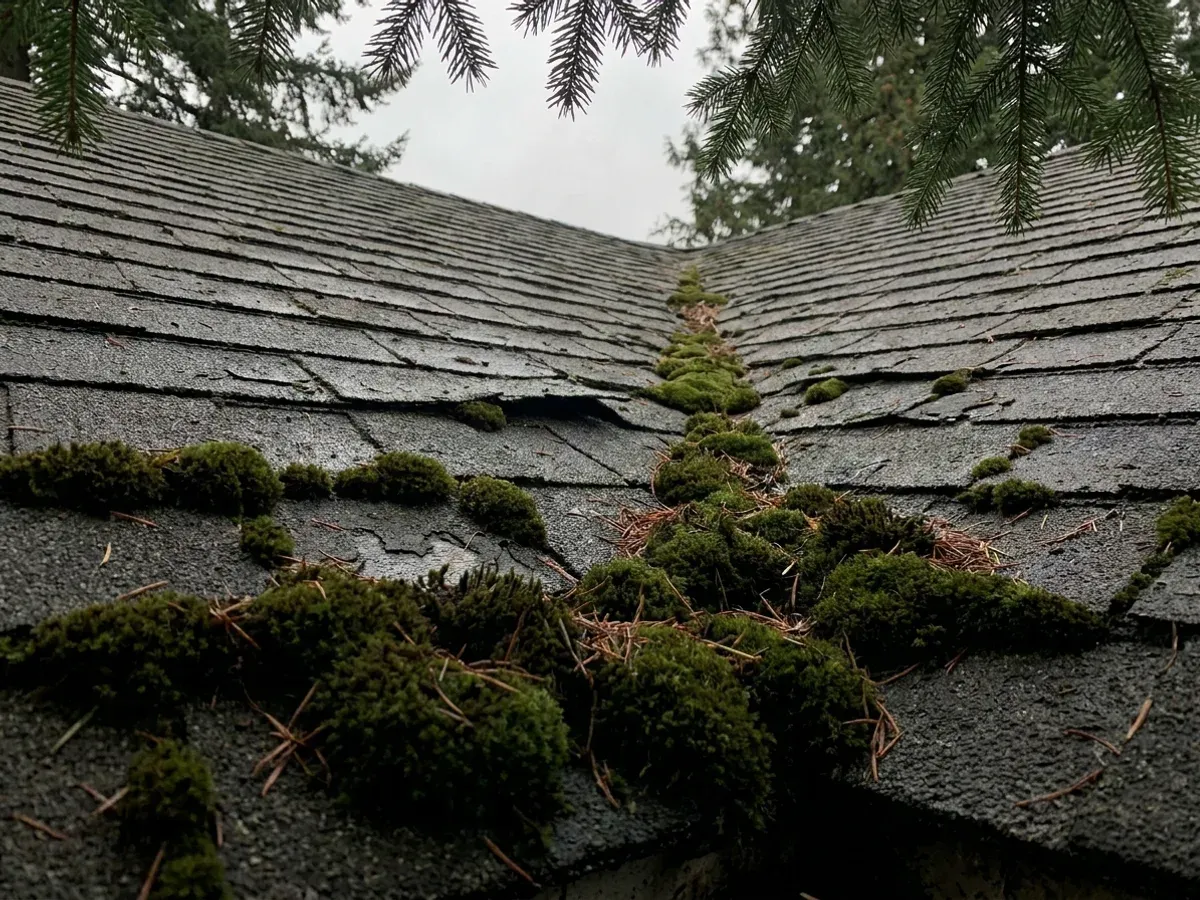
- Hand removal that leaves shingle granules where they belong
- Lifted shingle edges laid back down before winter
- Gutters and valleys cleared of the debris moss feeds on
- Method matched to asphalt, tile, metal or cedar shake
- Plants, ponds and ditches below the work protected from runoff
- Licensed and insured, and based right here in the valley
Moss on a Cowichan Valley roof is not a cosmetic problem that got out of hand. It is a water problem. Moss is a sponge sitting on a surface designed to shed water fast, and almost everything that goes wrong afterwards follows from that single fact.
The valley sits in the Coastal Douglas-fir zone. Wet winters from roughly October through March keep roof surfaces damp for months at a stretch, and the dry summer that follows is long enough to brown moss off but not long enough to remove it. Add a Douglas fir, a western red cedar or a bigleaf maple hanging over the roofline, and the needles and leaves that drop hold moisture against the shingles long after the rain has stopped. That is the whole recipe, and it is why this valley grows moss on roofs the way other places grow it on stumps.
What Moss Actually Does Up There
Moss holds water against the roof instead of letting it run off. Over time it wicks under the lower edges of the shingles and lifts them. Once an edge is lifted, wind gets under it and water gets behind it.
Then the cold arrives. Water trapped under a lifted shingle freezes, expands, and prises the shingle further apart. Thaw, refreeze, repeat across one winter and the gap grows. That sequence is how a green roof becomes a leak, and the leak usually announces itself on a ceiling long after the point where it was a cheap thing to deal with.
Moss is worst in predictable places. North-facing slopes get the least sun and stay wet longest. Anything under an overhanging branch stays shaded and catches debris. The lower third of a slope is where needles and leaves wash down and settle. If you want to judge your own roof from the ground, look at those three places first.
Roof Cleaning Without a Pressure Washer
If you take one thing from this page, take this. Asphalt shingles must never be pressure washed.
The coloured surface of an asphalt shingle is a layer of mineral granules, and those granules are what shields the asphalt underneath from ultraviolet light. A pressure washer strips them. You get a roof that looks dramatically clean for a season and then ages far faster than it should, because the asphalt is now sitting in the sun with nothing over it. People find granules in the gutter afterwards and assume that is normal cleaning debris. It is the roof.
Anyone who turns up with a pressure washer and a ladder is selling you years off your roof in exchange for one afternoon of curb appeal. Cedar shakes are the same story for a different reason, since driving water into shake is a good way to leave it holding moisture.
Roof Demossing by Hand
The method that works is slower and less impressive to watch. Moss comes off by hand with a plastic scraper and a soft brush, working down-slope so the tool never catches a shingle edge and lifts it. Wire brushes and metal scrapers do real damage and have no place on a roof.
Whatever is left after the physical removal gets treated so it dies back rather than being scoured off. Roots hold into the granule surface, and pulling harder to get every last trace does more harm than leaving it to die and weather away on its own.
We work the valleys and the lower courses hardest, because that is where the debris collects and where the moisture sits longest.
Your Roof Type Changes the Job
The four common roofs around Duncan and the surrounding valley each behave differently.
- Asphalt shingle — the most common and the most fragile. Hand work only, down-slope, no pressure.
- Concrete and clay tile — walkable, but only on the right points. Stepping wrong cracks tiles, and a cracked tile is a new problem, not a cleaned one.
- Metal — durable underfoot, but moss grabs at the seams and the fastener rows where water sits. Those lines are the work.
- Cedar shake — already holds moisture by nature. Gentle removal, never pressure, and the debris out of the keyways matters as much as the surface.
Gutters, Valleys and Where the Water Goes
A moss job that stops at the shingles is half a job. Moss growth fills gutters with debris, and a blocked gutter pushes water back under the roof edge and down the fascia, which is how the wood behind your eaves starts to go.
Everything that comes off the roof also has to go somewhere. Plants, ponds, ditches and eventually the Cowichan River system are downhill of somebody's roof. Protecting what is below the work — beds, shrubs, water features, the ditch at the road — is part of doing it properly, not an extra.
What the Roof Looks Like Afterwards
Being straight about this saves disappointment. A demossed roof does not look brand new the day the ladder comes down.
The heavy growth is gone and the roofline reads clean, but the treated remnants take months to fully die back and weather off with rain and wind. That is the process working as intended. The alternative, scrubbing until every trace is gone in one visit, is exactly the pressure-and-force approach that costs you shingle life.
What you get immediately is a roof that is shedding water again, gutters that are running, and edges that are lying flat where they should. The rest arrives gradually over the following seasons.
How we do it
- 01
Roof and ground assessment
We walk the property and look at slope direction, overhanging trees, roof material and the state of the lower courses. Anything already lifted, cracked or failing gets pointed out to you before work starts.
- 02
Protecting what is below
Beds, shrubs, ponds and downspout outlets are covered or diverted before a single scraper touches the roof. Runoff from a roof ends up in the yard and eventually the ditch, so it gets managed first.
- 03
Hand removal down-slope
Moss is lifted with plastic scrapers and soft brushes, always working down the slope so shingle edges are never caught and pulled. Valleys and the lower third of each slope get the most attention because that is where debris sits.
- 04
Treating what remains
The residue left in the granule surface is treated so it dies back rather than being scoured out. This is the step that lets the roof finish clearing itself over the following months.
- 05
Gutters, cleanup and walkthrough
Gutters and downspouts are cleared of the debris that came down, and the grounds are cleaned up. We then walk you through what we saw on the roof and what to watch.
Roof Moss Removal across the valley
We cover the whole Cowichan Valley. Pick your community to see what the conditions are like there.
Roof Moss Removal — common questions
Can you just pressure wash my roof and be done with it?
No, and we would turn the work down rather than do it. Pressure strips the mineral granules off asphalt shingles, and those granules are the only thing protecting the asphalt from UV. It looks impressive for a season and takes years off the roof.
Why does moss keep growing on one side of my roof and not the other?
Almost always because that side faces north. It gets the least sun, dries out slowest and stays damp through our wet season from October into March. Overhanging Douglas fir or bigleaf maple makes the same difference on any slope.
My roof still has green patches after the work. Did something go wrong?
No, that is how the method is supposed to look. The treated remnants die back and weather off with rain and wind over the following months rather than coming off in one afternoon. Scrubbing every trace out in a single visit is what damages the shingle surface.
Is my roof safe to walk on?
It depends on the material. Asphalt and metal are generally walkable with care, while concrete and clay tile crack if they are stepped on anywhere but the right points. We assess that before starting and work off ladders or planks where walking is not sensible.
Should I get this done before winter or after?
Either works, though clearing before the wet season means the roof goes into the winter shedding water properly and with gutters that run. Doing it in the drier months also gives treated remnants a longer stretch of weathering time.
Get the moss off before the winter rain sets in
Free quotes across the Cowichan Valley. Tell us about your roof and we will tell you what it needs.